Error message
Deprecated function: session_set_save_handler(): Providing individual callbacks instead of an object implementing SessionHandlerInterface is deprecated in drupal_session_initialize() (line 245 of /var/www/jlo/includes/session.inc).
CERN-ATLAS
Submitted by admin on Mon, 24/02/2025 - 15:30
 In 2024, the ATLAS experiment published in Nature the first observation of quantum entanglement at the highest energies, specifically in a system of top quark pairs produced in proton-proton collisions at the LHC accelerator at CERN.
Submitted by admin on Sat, 09/09/2023 - 13:05
The LHC accelerator at CERN does not collide just protons, but also heavy nuclei, e.g. lead. In such collisions, conditions close to those as shortly after the Bing Bang can be simulated. In an early Universe the matter was in the state of a hot quark-gluon plasma and the top quark, the heaviest of all quarks, constitutes a new unique probe to study this form of matter. Owing to its large mass, it is born in processes leading to the quark-gluon plasma, rather than in the medium itself. Comparing processes known from proton-proton collisions to those with heavy ions, it is possible to study their production mechanism and use them as a probe testing the development of dense strongly interacting matter.
Submitted by admin on Thu, 06/04/2023 - 09:48

On the occasion of the 10th anniversary of the experimental confirmation of the existence of the Higgs boson, the ATLAS and CMS collaborations at the LHC accelerator at CERN released in 2022 the most extensive overviews of experimental verification of its production methods to date [1,2]. Specifically, it concerns measuring its production rate, including the associated production with a pair of top quarks, and its decay fractions to different particles, from two photons, Z or W bosons to pairs of b-quarks.
Submitted by admin on Wed, 27/10/2021 - 08:56
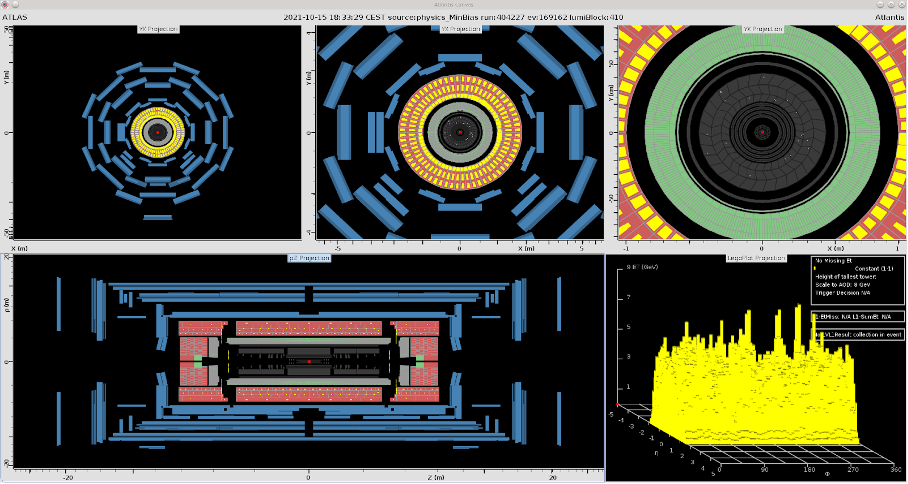 First beam splashes delivered by the LHC accelerator at CERN were observed by the two major experiments ATLAS and CMS. After almost two years of shutdown filled by accelerator and detectors upgrades, a new Run 3 of the LHC commences.
Pages