Dinu, M; Lindner, T; Tomastik, J; Vranceanu, DM; Pana, I; Parau, AC; Vitelaru, C; Lampke, T; Mirzayev, M; Vaclavek, L; Vladescu, A:Tailoring structure and functional performance of cathodic arc TiSiCN coatings for wood-cutting tools via C/N gas flow control in cathodic arc deposition,Surf. Interfaces 97110243(2026).
Halim, AA et al. (Cerny, K.; Chytka, L.; Hamal, P.; Horvath, P.; Hrabovsky, M.; Jilek, V.; Mandat, D.; Michal, S.; Nozka, L.; Palatka, M.; Pech, M.; Schovanek, P.; Svozilikova, Z.; Vaclavek, L.; Vacula, M.):Quasi-Constant Time Gap in Multiple Rings of Elves,Earth Space Sci. 12(10)e2025EA004321(2026).
Abe, K et al. (Chytka, L.; Hrabovsky, M.; Mandat, D.; Pech, M.; Vacula, M.):Detection of the distant quasar OP 313 with the first Large-Sized Telescope of CTAO,Astron. Astrophys. 712A91(2026).
Halim, AA et al. (Cerny, K.; Chytka, L.; Hamal, P.; Horvath, P.; Hrabovsky, M.; Jilek, V.; Mandat, D.; Michal, S.; Nozka, L.; Palatka, M.; Pech, M.; Schovanek, P.; Svozilikova, Z.; Vaclavek, L.; Vacula, M.):Depth of maximum of air-shower profiles above 1017.7 eV measured with the fluorescence detector of the Pierre Auger Observatory,Phys. Rev. D 114(4)43016(2026).
Aad, G et al. (Cerny, K.; Hrabovsky, M.; Kvita, J.; Nozka, L.; Privara, R.):Calibration of the jet energy scale and resolution of small-radius jets using semileptonic t(t)over-bar events with the ATLAS detector,Eur. Phys. J. C 86(8)943(2026).
Abe, K et al. (Chytka, L.; Mandat, D.; Pech, M.; Vacula, M.):Constraints on the VHE Counterpart of Two Binary Black Hole Mergers Observed by the MAGIC and CTAO LST-1 Telescopes,Publ. Astron. Soc. Pac. 138(8)84101(2026).
Aad, G et al. (Cerny, K.; Hrabovsky, M.; Kvita, J.; Nozka, L.; Privara, R.):Combined effective field theory interpretation of measurements sensitive to quartic gauge boson couplings in pp collisions at √s=13 TeV with the ATLAS detector,Phys. Lett. B 879140683(2026).
Aad, G et al. (Cerny, K.; Hrabovsky, M.; Kvita, J.; Nozka, L.; Privara, R.):Breaking barriers: the impact of ATLAS Virtual Visits in science communication,Eur. Phys. J. Plus 141(7)874(2026).
Aad, G et al. (Cerny, K.; Hrabovsky, M.; Kvita, J.; Nozka, L.; Privara, R.):Effective field theory interpretation of ATLAS measurements involving the Higgs boson, electroweak bosons and the top quark,J. High Energy Phys. (7)238(2026).
Aad, G et al. (Cerny, K.; Hrabovsky, M.; Kvita, J.; Nozka, L.; Privara, R.):Missing-mass search in forward-proton-tagged dilepton events with the ATLAS detector,J. High Energy Phys. (7)236(2026).
Aad, G et al. (Cerny, K.; Hrabovsky, M.; Kvita, J.; Nozka, L.; Privara, R.):Search for long-lived charginos and τ-sleptons using final states with a disappearing track in pp collisions at √s=13 TeV with the ATLAS detector,J. High Energy Phys. (7)152(2026).
Barasinski, A; Perina, J; Cernoch, A:Quantification of Quantum Correlations in Two-Beam Gaussian States Using Photon-Number Measurements,Phys. Rev. Lett. 130(4)43603(2023).
The observation of associated production of the top quark pair and the Higgs Boson is a process where direct interaction of these two heaviest particles of the Standard model of elementary particles comes into play. The production of the Higgs boson is accompanied with the top quark pair creation only in about 1% of events and for the observation of this process data from several decay channels have been combined.
Geneva, 14 August 2017. Physicists from the ATLAS experiment at CERN have found the first direct evidence of high energy light-by-light scattering, a very rare process in which two photons – particles of light – interact and change direction.








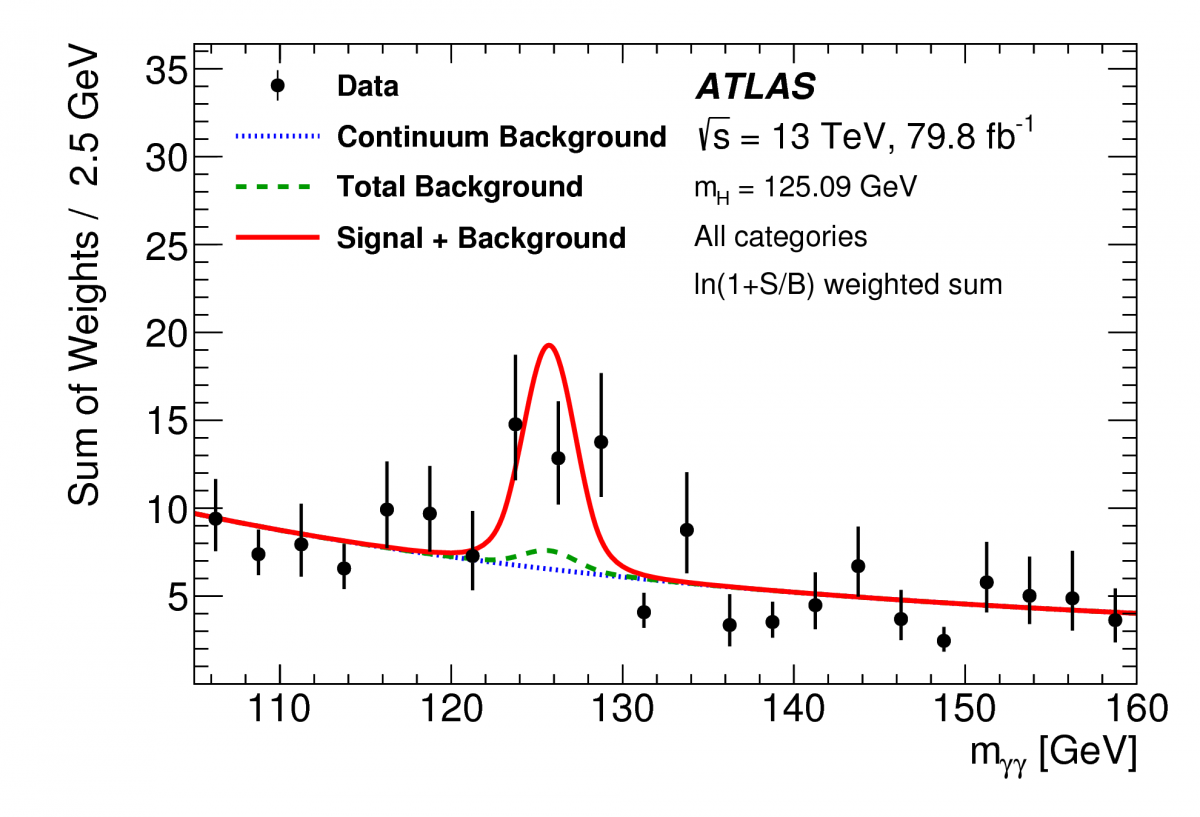 The observation of associated production of the top quark pair and the Higgs Boson is a process where direct interaction of these two heaviest particles of the Standard model of elementary particles comes into play. The production of the Higgs boson is accompanied with the top quark pair creation only in about 1% of events and for the observation of this process data from several decay channels have been combined.
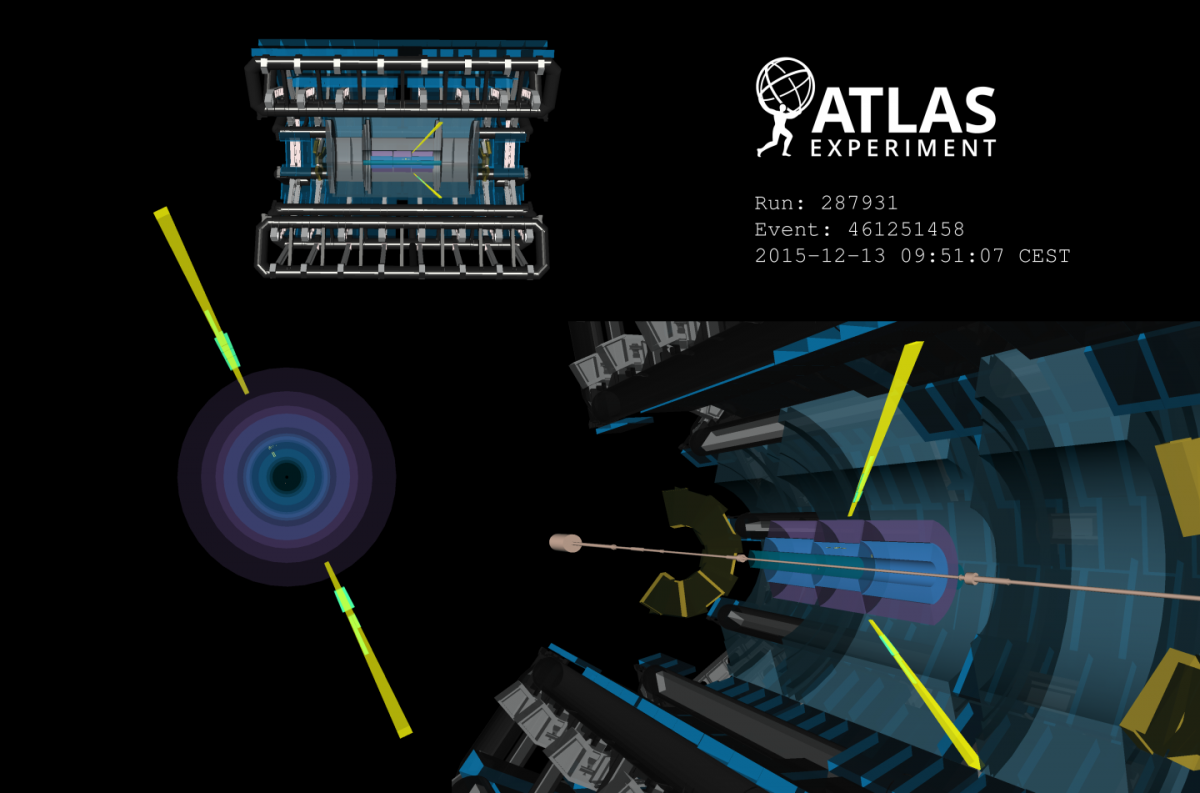 Geneva, 14 August 2017. Physicists from the ATLAS experiment at CERN have found the first direct evidence of high energy light-by-light scattering, a very rare process in which two photons – particles of light – interact and change direction.